That Good: Dispatch


Welcome to That Good, where I take a closer look at critically acclaimed work to determine if its really "That Good." By far the most recent subject we've tackled on this program is what we'll be talking about today: Dispatch. Released in October of 2025, it took the gaming world by storm and has cemented itself already as something of a modern classic. As someone who loves a good choice-based game as well as any and all superhero media, I felt that that this was match made in heaven.
This will be a deep dive review, meaning I'll be discussing all elements of the game (story, presentation, gameplay) and my thoughts on them. If you're at all on the fence about playing Dispatch, my expedited review is this: you should. Its a great experience for only $30 dollars. It looks great, has fun characters, and some refreshing gameplay. If you need that Telltale itch scratched, Dispatch's got you. Past this point, we're going full spoilers. You've been warned. (Just play the game.)
Presentation + World:
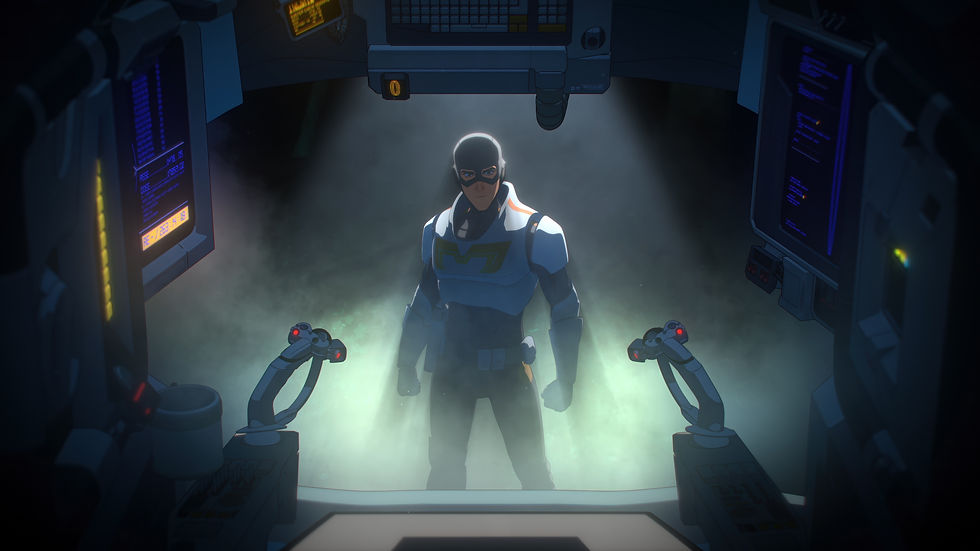
The world of Dispatch is pretty familiar to any fan of superheroes. The overall arc of the story, which sees disgraced superhero Mecha Man AKA Robert Robertson III, retire and become a dispatcher for SDN, or the Superhero Dispatch Network, is the perfect excuse to run into the oddball characters of this world.
While it might look like Invisible visually, this universe better resembles that of Marvel and DC in the temperament of its characters. There's a clear love for Marvel in particular, specifically the X-Men, with how Prism and Malevola are pastiches of Dazzler and Magik specifically. Some references are more on the nose, like Sonar being a literal bat-man/man-bat and Golem resembling Clayface, but in the deviations from the mold are what make the off-kilter world of Dispatch unique:
The Z-Team are like the characters you know and love...if they were losers.
Visually, however, I appreciate that these characters are pretty distinct without falling into modern superhero design pitfalls. By doubling down in simpler, silhouette-cutting designs that are reminiscent of old-school caped comics, I'd go as far as to say that Dispatch has crafted better designs than Marvel or DC have in some time. The Z-Team is sorely lacking in any icons/symbols/emblems for its members, but going for simpler, blockier designs versus over-detailed, complex ones makes every character easier to identify and understand. Prism, Coupe, Blonde Blazer, and Mecha Man are some of my favorites, but not all are created equal.
My one criticism of the style of Dispatch is that it has a kind of knock-off, generic quality that is only overcome by actually getting to know the characters. I mean, Maleveloa isn't actually Magik because she doesn't have nearly as much depth as Illyana Rasputina, so they'd never be confused for one another. That's a bit harsh, but the smoothed, simplistic nature of the general artstyle does make the world feel plastic and generic at times, which is helped by characters sometimes just being caricatures. Phenomaman is a prime example. The primary colors allude to him being a Superman type, but that's about as deep as it goes. At worst, this choice ends up making the design feel non-specific and cheap. The artstyle is a double-edged sword. You can decide if it works for you, but I'm split. Some costumes are good, others feel like they needed another pass.

And to get this out of the way—yes, there are comics about the cast in the deluxe edition of the game, and no, I didn't read them, (although I'd love to). I simply don't think they're worth 10 more dollars, and honestly, they ought to be included in the base game. I acknowledge this because if any criticisms I go on to name are solved in those comics, I don't care. This review is about the base game and nothing else.
Anyway—one thing I really wished I had known more about was the superhero world outside of SDN. The scale of this story is very small, which is fine, but it doesn't allow for any insight into the larger world of Dispatch, only its southern California. I appreciate the West coast setting, as Marvel and DC have always been attached to the East coast, but we don't actually know much about this world beyond the characters we meet and their small lives. The Southland has villain and hero bars (like The Bar With No Name/Oblivion Bar) and an A-list team called the "Brave Brigade" (like the Justice League or Avengers). SDN seems to be the backbone infrastructure of superhero-ing, so caped crusaders have been throughly accepted in this world, but that's all we can really infer. I understand this story is smaller and character-focused, but better understanding where the Z-Team, Mecha Man (as well as the previous Mecha Men), and Blonde Blazer fit into this big world of heroes would have made their journeys matter a little more. Mecha Man being a "real" superhero doesn't carry too much weight when we don't know many other "real superheroes" to begin with.
An observation I've come away from Dispatch with is that this game has genuine filmmaking chops. We'll get to performances later, but when it comes to framing and action choreography, Dispatch doesn't skip out. One of my favorite shots is at the end the now iconic suit-up sequence in the first episode, which is later referenced in the final episode with the return of the Mecha Man suit. Its not often said, but Dispatch has some damn good cinematography. The opening shot of Robert on the floor is particularly clever, as it makes you believe he's standing against a wall until the blood comes down his nose. It honestly reminds me of something out of Better Call Saul or any number of restige drama shows. Furthermore, Prism falling through Malevola's portal in the finale is always electric, as well as many of the hero shots as the Z-Team unite to fight Shroud. The plot and budget of the game don't afford it many opportunities to go all out, but when Dispatch does, these moments truly pay off.
Gameplay:

True to its name, Dispatch has you dispatching your suite of heroes to put out fires both literal and metaphorical across the town of Torrance. Each character has a spread of stats (Vigor, Combat, Intellect, Charisma, Mobility) and picking the best heroes for the job is the real test of skill here. These sections are really fun, since they test your reasoning skills when it comes to numbers and human nature. A character might have the appropriate stats to get the job done, but might not be the best fit overall because of a personality quirk or simply their appearance. Throw in abilities, synergies, stat thresholds and contextual story elements, and you have a sturdy backbone for a fun, strategic system of gameplay.
To get into the nitty-gritty, hero abilities and synergies are only really discovered through experimentation. For example, I went my whole first playthrough without sending Invisigal and Golem on a mission together so I never knew they had a synergy. That being said, you won't need to rely on these if you're simply sending the right heroes with the right stats to accomplish the right task. Sure, its feels great to get a clutch victory by using Prism's copy power or boosting the likelihood percentage with a synergy assist, but simply investing your skill points correctly is the bread and butter of gameplay. I like synergy in theory—it expands on pre-established relationships, opens up new ones, and incentivizes risk-taking—but a mechanic that can be completely ignored is a bit of a bummer. Besides, some pairing are odd. Ones like Punch-Up and Coop or Flambae and Prism just make sense while Phenomaman and Malevola feel like a grasp at straws.
Hero abilities add flavor by giving the player bonuses for playing smartly. Flambae's stats getting juiced for continued successes or Malevola being able to heal your other heroes gives you more options as the game progresses, and while I adore the dispatching gameplay, it can feel stale at time. In the end, you're just clicking X on the same map. At least Fire Emblem sometimes puts you on a pirate ship or something. These powers are typically pretty good across the board, though. Prism's copying power, Coupe being able to redo a failed job, and Invisigal finishing solo jobs faster are all game-changing, distinctive attributes.
Sometimes regular dispatching, as well as story events, are interrupted by the need to do some hacking. Unfortunately, the hacking sections suck. You move a shape along a grid, sometimes having to remember a sequence of analog stick movements to open your way forward, open up pathes with electricity, or avoid evil red orbs that will kill you. These sections are the worst combination of boring and frustrating.
During a shift, they can be particularly stressful since failing them can result failed job, but you can enable unlimited attempts in the settings menu to keep your sanity. What I do appreciate about the hacking, however, is that its a canonical way for Robert to help the Z-Team from the chair. Hacking can provide an out when your hero's stats can't cut it or prevent the need to send anyone out in the first place. Besides this story-gameplay integration, I was never excited to do any hacking.

Speaking of story-gameplay integration, its seen most clearly in the dispatching itself. There are many times in which your decisions in the story affect your roster of heroes. Most apparent are the decisions to cut Coupe/Sonar or to add Phenomaman/Waterboy. These change not only the heroes at your disposal but the ones featured in some story scenes throughout the game. After cutting a hero in episode 3, you'll feel the struggle of being shorthanded in your next shift, as well as the effects of low team morale. In episode 8, defending Invisgial will result in your remaining team members beginning with reduced stats, again a result of low morale due to a choice in the story.
This stuff just really tickles me. The marriage of the two halves of the game is done smartly but not too punishingly. I biffed a lot of my first playthrough, (I blame the flu I didn't know I had at the time) but despite fumbling through most shifts I was able to save the day. You're allowed to make your own decisions, as well as your own mistakes, without soft-locking yourself.
I will say, however, that there's definitely a dominant strategy. In my first playthrough, I really enjoyed throwing my skill points around and experimenting with the builds of my heroes. Giving Golem a high mobility stat and working on Waterboy's charisma just felt like the kind of wacky strategy that the spirt of the game invited, but ultimately, I spread my stats too thin and had a hell of a time on my last shift. Sure, this was my mistake, but in my second playthrough, it was boring simply doubling down on the character's strengths. I simply wish I was allowed to experiment with the stats without knee-capping myself in the long run.
The last part of gameplay I want to mention is QTEs, or Quick Time Events. This style emerges most predominantly in the first and final episodes when Robert fights in the Mecha Man suit. The disadvantage this system has always had that the movement on screen could be interesting and impactful but all you're doing is a pressing a button, and with Dispatch's limited button-pushing opportunities, this is a pretty shallow element to the game. Its great seeing Mecha Man in action since the action is always choreographed well, and the QTEs do lend some tension to the scene, but part of me always wanted to know what these scenes would be like to experience when I was distracted.
Overall, Dispatch's gameplay is strong and offers a great platform to build on in later games (fingers crossed). The way that the devs at AdHoc have set a precedent for the story affecting the dispatching has left the door open for even more inventive ways for a second season to iterate on is rather exciting.
Story + Writing:

Dispatch is the story of Robert Robertson III, AKA the superhero Mecha Man, as his quest to avenge his father, the previous Mecha Man, has resulted in the destruction of his suit. He pivots to a new role as a superhero dispatcher as SDN while they rebuild his suit. Robert's dad was killed by a villain, who was once a hero, named Shroud, who remains at large. As Robert, the player is tasked with whipping into a shape the Z-Team, a crop of ex-villains that SDN has turned into heroes. The bond between Robert and the team takes center stage of he meditates on the ideas of heroism, redemption, and whether or not the role of Mecha Man or dispatcher suits him now.
I love this premise.
Robert is such a compelling character right off the bat; he's a respected, seasoned superhero but he slips up, gets personal, and pays for it, resulting in the player getting the chance to rebuild him from the ground up. This will be the part where we discuss dialogue options, because I find it so impressive how the choices presented to the player always feel like something Robert would say, regardless of how you want to play it. In my first playthrough, I got the "true hero" profile since I tried my best to "do the right thing" in every situation and kept my Robert an honest, straight shooter. Instead of asking what I, Adam Buckley, would do, I asked what Robert would do. I could see, however, someone playing Robert like a real bastard. Its established early on that he takes his job seriously, and this affords the player the latitude to be believably asshole-ish in a workplace setting. Hitting Golem (my beloved) with a chair is a bit much, but I can see Robert, as I know him, pushed to that extreme.
Furthermore, Robert stands as the most deeply characterized player in the story. Of course, that comes with being in every single scene, but its clear he's in a different league than the others because they simply don't possess the same depth as him. His construction is smart because the death of his father and the destruction of his suit pushes the player to choose how he reacts to his new life at SDN. You can see it as a new beginning 0r just a pitstop along the road to being Mecha Man again. Robert's insistence that he's still a hero even without the suit can be rendered as perseverance or simple denial. What helps is that there are moments free from player control that characterize him, my favorite being how he says "I never felt silly wearing this..." about his Mecha Man costume. This bolsters the fact that Robert is not a player-insert character. He's distinct, and your role is to shape his journey, not dictate who he is.
Speaking of the dialogue, we have to talk about it. As a genre cocktail that's oft described as "superhero workplace comedy," Dispatch is always trying to be funny but not always succeeding. There are some gags that always get me, ("Cool dick," "Are those my earrings?", "Why're you accepting hugs from old men ya don't know?") but the game will never escape the "Reddit" allegations. Personally, I don't actually think "Reddit" is a good descriptor, but it does have that overly clever, millennial, MCU-adjacent quippiness that proves grating over time. Nearly every emotional moment is followed up by a foul-mouthed gag that threatens to undercut its earnestness. I can accept that the Z-Team, who are established to be emotionally stunted assholes, acting in this manner, but pretty much every character, including the straight-laced Blonde Blazer, produces quips like they're getting paid to do so. Sometimes this works, like the impeccable comedic timing of Waterboy's cacophonous fart interrupting Robert and Visi in the bathroom, but then there's a joke about a Z-Team orgy after telling them you're Mecha Man. Hell, the emotional climax of the story hinges on the bad guy shooting your dog. If that isn't Millennial, I don't know what is.
This brings me to my next point about the humor: some of this shit is just straight up sexual harassment. I don't wanna be the friend that's too woke here, but there were only so many times I can notice this and not feel some way about it. I'm not sure what Dispatch's point is for including this. Blonde Blazer, Invisigal, and Malevola all violate Robert in varying ways, some more explicit, or played for comedy, than others, and I think discussing it might prove fruitful in deciphering the game's commentary (if there is any) about corporate culture. We've talked about the "superhero" and "comedy elements" but not the "workplace," and I intend to correct that.
Robert is headhunted under the guise of a post-save date with Blonde Blazer and then is immediately saddled with more responsibility than a typical dispatcher as he must rehabilitate the Z-Team, which places him in mortal danger many times. I understand the narrative necessity for this escalation, but with Blonde Blazer as a romance-able character, you can effectively forgive her for this workplace abuse wholesale. Early on, I pegged Blazer making Robert strip for her to be some indicator of villainy, or at least a sign that Blazer had something else going on. She doesn't, but we'll get to that later. As it stands, it just makes the moment rather odd. The player can change the charge of the moment by choosing to lean into Blazer as a romantic partner, but if not, Blazer comes off as insanely creepy for no apparent reason other then to set up an HR joke, which is often the punchline to uncomfortable workplace scenarios in this game.

Invisigal, in her pursuit of Robert, is also incredibly inappropriate. She peeps on him at least twice while invisible, then confronts him in the men's bathroom to discuss her sex dream about him. Malevola, too, just gropes Robert twice out of nowhere. I'll deflect the snowflake allegations by saying that yes, the Z-Team are supposed to be reformed villains, so some shitty behavior is expected. This attitude is embodied in Flambae, who tries to melt you into a puddle after you reveal your identity, but at least he never becomes a sex criminal in his hatred of Mecha Man.
The inclusion of these moments does contribute to the overall theme of navigating sticky workplace relationships, but I fear it doesn't accomplish what it sets out to do. Robert is constantly surrounded by characters who transgress his boundaries in overt ways (Malevola, Invisigal) and more subtle ones (Blazer). This contributes to a complete degradation of these boundaries as these character are effectively forgiven (depending on the ending, I suppose) and established as a kind of found family by the end. These trangressions are then classified as the language in which these broken people communicate. It works when its slapstick, like Golem punting Punch-Up through a door, not when its a sex crime. Of course, Robert might be so dead inside that he simply doesn't care about these violations, although "canon," non-player dictated reactions on his part would indicate otherwise.
I don't think that Dispatch is actually about workplace relationships. SDN is a convenient setting to centralize the theme it really wants to discuss: redemption. Can Robert redeem his failure as Mecha Man? Can Invisigal make up for what she did to Robert? Are Robert and the Z-Team really all that different? These are the compelling questions at the heart of the story, and these characters being coworkers might make for some comedic moments, but it creates as many problems as it does jokes.
Moving on from this depressing topic, I have other things to complain about. I appreciate that the game hardly uses flashbacks, but its a shame that Robert's main motivation is to avenge his father, a character we've never met and only hear bad things about, in killing Shroud, a pretty weak villain with a weaker motivation himself. The Astral Pulse, another pivotal yet boring element of the story, might as well be named the Plot Device—it powers the Mecha Man suit, but that doesn't mean the audience cares about it. Shroud needing it to do...villain stuff, makes one of most deflating villains I've seen in a long time. Outside of his respect for Blonde Blazer, Shroud has nothing going on under the hood. We don't know his relationship to Robert's father, why be became a villain after being a hero, and without a better explanation for why he needs the pulse, he proves to be one of, if no the worst characters in the game.
Sorry, Matt Mercer.

Finally, let's talk about the ending. Playing twice, I've seen a few permutations of what can happen, and none left me truly happy. In my first one, I romanced Blazer at the cost of Invisgal's soul, leading her to become a villain, so she was the one who killed Shroud. I failed to defeat Sonar in my final dispatching shift (I blame the flu) so he went to jail. This contrasts my second playthrough where I romanced Invisigal, killed Shroud, and defeated Coupe to ensure she didn't go to jail. Your cut Z-Teamer being forgiven in the end is cheap, even by this game's touchy-feely standards, and there basically be no consequences for killing Shroud felt like an oversight. And we haven't even talked about how Trackstar using Mandy's gem comes entirely out of nowhere if you didn't go on Blazer's date. I don't mind the twist, although I wish the game had the gaul to really kill Chase, but its certainly another oversight that the gem isn't set up beforehand, regardless of your choice.
There are some small things I'd like to mention before we move on. The framing of the Z-Team as some kind of found family is—and I hate to be crass—some horseshit. I won't go into my distaste for the oversaturation of the found family trope, particularly when its this poorly implemented, but here it really is distracting. Simply put, I found it to be a cheap emotional chsortvut the game employed because it ran out of room to develop this bond organically. This is something I praised Thunderbolts* for sidestepping. That film pulls of what the Z-Team cannot—developing the characters and their bond before giving them a label. Oh, and the choice to keep or cut Invisigal is also horseshit. The reaction from the rest of the Z-Team is jarring, and neither decision feels correct because the context is completely at odds with the choice. All the player knows is that she stuck her neck out of us, like a real hero would, and the game punishes you for returning the favor. I can't tell if this is just the game being out of step with the player's priorities, or the Z-Team's shitty behavior making a return, but its a strangely moment that both compels and frustrates me.
I know I was very critical in this section, and it seems like I hate the game's overall story, but that's not true. I do believe, however, that the game's overarching plot is its weakest element. Its simply not the game's priority. Dispatch's strength is the moment-to-moment decision making because that's where the player is most engaged, so when it tried to build to something greater, it lacked the time to properly develop that in order to deliver a proper conclusion.
Characters + Performances:

Switching to a more positive gear, Dispatch has a cast of easily identifiable characters that come to grow on the player. Beyond their designs, their personalities are familiar enough to become attached but each character proves to be charming the more time you spend with them...mostly. Beyond Robert, I'd classify Chase, Invisigal, and Blonde Blazer as the "main characters" of the game, or at least "deluxe supporting cast." These are the characters most important to Robert, as even Flambae, who is established as a rival early on, is eclipsed by the aforementioned four.
Aaron Paul as Robert turns in a really great performance for what he has to work with sometimes. His gravelly yet warm voice suits the dejected, yet heroic Mecha Man no matter how you play him. Paul pulls off even the most cringe of lines by doubling down on Robert's deadpan, dead inside demeanor that so well juxtaposes the colorful chaos of the Z-Team. His voice is the key the unlocks the rest of Mecha Man, one of the best realized protagonists in gaming.
Chase AKA Trackstar, is one of my favorite characters. He can be a bit much sometimes, but Jeffery Wright's voice was perfect for this role, and the way that he and Robert's relationship is handled is quite touching. Having a character like him around, who always has Robert's back, reassures the player who has doubts about the Z-Team. His sacrifice ("Keep Up") is one of the most arresting moments in the game. He reminds us what a real hero looks like just before the game throws Robert in the deep end. His hyper-aging also lends a wisful element to him. He's only about 40, but with the body of an octogenarian, he's resigned to the role of dispatcher. His fate is meant to make us, as well as Robert, reflect on how far Mecha Man has fallen, but his sacrifice to save Visi also shows that even though he and Robert aren't super anymore, they're still heroes. Its corny, but the game's more earnest moments are always my favorite.
Here, I'll talk about the Z-Team broadly. Because they're mostly characterized through gameplay, its only fair that people have their favorites. I'll always love Golem despite his limited screentime because juicing his movement stat and watching him solo his assigned missions brought me joy. By that same token, I hardly ever used Punch-Up, making him my least favorite member of the team. Flambae, Prism, and Coop caught my attention by being consistently reliable during shifts. When it comes to voice acting, the choice to bring in e-celebrities like Jacksepticeye (Seán McLoughlin), MoistCr1TiKal (Charles White) and Alanah Pearce could have been catastrophic but all of these people put in good work as their respective Z-Teamers. Even Yung Gravy is good here. (I expect to see bbno$, Fred, and EpicLloyd in season 2). Travis Willingham lends his might voice to Phenomaman, a character I'm overall lukewarm on, but never failed to make me laugh. Waterboy, voiced by Joel Haver, is instantly endearing, and being able to help him find confidence, and thereby work on his stutter, shows how impactful Robert is on the lives of the Z-Team.
Thotsquad and Lance Cantstopolis as Prism and Flambae respectively might be my favorite performances. Not only are they my favorite duo, but I feel as if casting for both of them truly bring out the most entertaining aspects of their characters. Besides, getting a real artist to play Prism was inspired. In terms of character, Flambae is actually the one who surprised me most. I adore how he has his changed of heart off screen, since he's such a diva that he wouldn't want even the audience to see him warming up to Robert. Their rivalry falls by the wayside in the latter half of the game, but its genuinely pretty engaging. I didn't like Flambae much on my first playthough, but he grew on me by being so damn entertaining. Prism, too. The Z-Team works best as a group, as few members really withstand scrutiny on their own, but as a collective, their damn charming.

Finally, we must talk about Blonde Blazer and Invisigal. Mandy and Courtney. In the voice department, I don't really think there's anything to write home about, so let's jump right into their characters.
Beginning with Blazer, I'll always love her simple yet strong design and the gimmick of her gem giving her powers (Brunette Blazer), but in terms of personality, she's a bit flat. Being so perfect, the audience expects the other shoe to drop with Mandy but it just never comes. We learn the secret of her gem but its a joke of a reveal. Literally. Being an authority figure at SDN would have added some tension if Robert and Blazer ever disagreed on anything regarding work. Blazer is like the Captain Marvel/Wonder Woman of this world in that she's its premiere female superhero, but she lacks any real hook beyond that. There are moments of implied darkness, like the stripping scene, or how she threatens the Z-Team at the party, but in retrospect, they are anomalies. I still don't really know who Blonde Blazer is by the end of the game since it feels like there was something about her left on the cutting room floor. It hate to get into rewriting territory, but I think if the story committed to Blazer being a company woman, someone willing to chew Robert up and spit him out for the good of SDN, she'd be far more interesting and appealing. Or maybe her tendencies to use people conflict with ehr self-image as a hero. I dunno, something! These "anomalies" indicated something more interesting that what is in the finished game.
Ah, Invisigal. I'm similarly conflicted about Courtney as I am Blazer but I'm much less uneasy about it since that was clearly the intention. The more I ruminate on the character, the more I appreciate how lifelike her shitty attitude is. She's likely to grate on you, annoy you with her pessimism, or even make you conformable with her advances, but I enjoy how the writing doesn't hold back. A person like Courtney would act exactly like this. I used to really hate the "I have villain powers" speech, and I still think it makes her look really immature, but assuming that's the point, the scene becomes even more compelling. Visi thinks because she can turn invisible, the powerset of one of the first and most influential superheroes, Sue Storm AKA the Invisible Woman, makes her a villain. Its obviously self-pitying and obnoxious, but by seeing her so low, the player can invest in building her back up like they Robert. It establishes a foothold in their relationship and serves a deeply characterizing moment for both of them.
My take on the romance element of the game is this: its tempting, but truly adds little. I never really saw how a relationship between Robert and Blazer connected to any of the game's themes. Its interesting from a characterization standpoint how Robert might gravitate toward a fellow "real" superhero as opposed to a Z-Teamer, but otherwise, it merely adds flavor to a playthrough as opposed to anything of true value.

On the other hand, pursuing Visi, while not my preferred option, at least connects to the themes of forgiveness and second chances. It rewards some bad behavior, as previously mentioned, but this goes for both of them. Of course, you can choose neither romance path without losing out on much. Blazer's romance, by virtue of being established earlier on, does have the benefit of adding smaller moments indicating she and Robert's intimacy, but that's it. Visi's, by virtue of happening at the very end, feels less worthwhile despite being more thematically relevant. One thing I'll say is that I find both options plausible. I could see a "true hero" Robert go for Blazer but an "antihero" or "everyman" Robert go for Visi since the core motivations are in Robert's character regardless of your choices. Nevertheless, the implementation of the romance is lopsided. There are pros and cons to either choice, which is preferable to one being superior to the other, at least. Every player can make their own choices, but after purusing both, I'm left wondering what the point was.
The elephant in the room is how both romances play up a male fantasy (cue the clip). This discourse has already made the rounds so I'll make this quick. I experienced some discomfort even considering a romance here because I felt so pandered to. You can either date the perfect superheroine or the bad girl you get to fix. Blazer being little more than what's on the surface doesn't help. I'm simplifying matters, and I don't think its wrong to service an audience, but video game romances are already some of the most tricky to mechanics implement, and rarely do they pay off in interesting ways. There are outliers (Mass Effect, my beloved) but its a fundamentally indulgent exercise to me. Maybe this is just a quirk of the genre that we've yet to truly master, and its true you'll never please anyone, but Dispatch doesn't exactly move the needle forward in that regard.
Conclusion:

Is Dispatch That Good? I'll say yes, but it does require a shift in perspective. Dispatch is a great game, not necessarily a great story, which complicates cases like this one, where the specific genre of game borrows so heavily from another narrative focussed genre. Dispatch explicitly apes tropes from television, right down to the game's structure and sitcom aspirations. It works very hard to become barely more than the sum of its parts, but like Lightning McQueen, it gets its tongue just over the finish line.
While the corner-cutting can be seen and felt, there's a reason why Dispatch took off the way it did. Sure, it has a celebrity voice cast, support from Critical Role, and appeals to superhero fans, but let's not forget that it has brought back the Telltale style game, a genre that once ruled the 2010's but has since gone the way of the dodo. Its filled in a hole in hearts of those still holding out for The Wolf Among Us season 2, but also anyone who misses high quality animated TV (ahem, Arcane). It became a touchstone of online fandom cultural overnight because the weekly release schedule gave people something to look forward to and talk about. Dispatch appeals to many different vectors and inherited the lapsed fans of derelict properties. With choice making gameplay being absorbed into the action RPG genre broadly (Cyberpunk, Baldur's Gate 3, etc.), it was able to give wayward fans a home. Even as a superhero property, it isn't some radical take on the genre, but a refreshingly different one that offers something novel for fans old and new.
If I had to give Dispatch an arbitrary number score, it'd be an 8/10. What Adhoc was able to accomplish with this game ought to be commended, but on a critical level, there's plenty of room to improve, namely in the writing department. In the future, I'd welcome a second season that seeks to resolve some of the core problem seen here, those being this season's plotting problem.
Nevertheless, I'm glad to welcome Dispatch into the club of "modern classics," since I truly believe we'll be talking about it for a long time. With the likes of Invincible and The Boys carving out a niche in mainstream pop culture for non-Marvel and DC superhero universes, it'd be a shame to let the world of Dispatch languish. I mean, is it so hard to produce a real, honest-to-god Dispatch comic to put on shelves? How are there not action figures for sale at GameStop as we speak?
Dispatch is here to stay because it really is That Good.


